The sun doesn't
send a bill.

The utility does — $242,000 a year, and rising. Wayne Trace can own its power instead.

Spent on utility power
since you opened this page
$0.00

≈ $27.63 every hour, school day or summer break

Watch the 20-second film

Today

$242,000

What Wayne Trace pays the utility, every year. At typical rate inflation, it doubles in 12–13 years. And at the end? The district owns nothing.

See the bill
Building / UtilityElectricity / yrProposed solar
High School PPEC / Buckeye Power~$126,000500 kW
Payne Elementary AEP Ohio~$59,000275 kW
Grover Hill Elementary AEP Ohio~$57,000275 kW
District total~$242,000 / yr1,050 kW

What if the district
owned its power?

Three arrays on district land. No lease. No third party. Just ownership.

A hedge.

Locks in energy costs for decades, insulated from every future rate increase.

An asset.

Pays for itself in about 6 years. Then runs nearly free on equipment built to last 30.

A classroom.

Real watts, real weather, real dollars — live data for every grade level.

The cost

50% back.

A federal direct payment — not a tax write-off — returns $1,050,000 of the $2.1M cost, boosted because Paulding County qualifies as a federal energy community. Net to the district: about $1.05 million, owned outright.

See the full math
Line itemAmountNotes
Total installed cost 1,050 kW across three sites~$2,100,000Conservative ~$2.00/W planning figure. At likely bid pricing (~$1.75/W), payback shortens by about a year.
Federal direct-pay incentive (50%) 30% base + 10% energy community + 10% domestic content– $1,050,000The 30% base is statutory. The 10% energy community adder is confirmed — Paulding County qualifies under IRS energy community guidance (Notice 2026-39). The 10% domestic content adder depends on final equipment selection. At 40%, net is ~$1.26M and payback ~7–8 yrs; at 30% only, ~$1.47M and ~9 yrs — the project works at every tier.
Net cost to district~$1.05MNo lease · no third party
Operations & maintenance Budgeted, not ignored~$13,000 / yr~$12–15/kW/yr: inspection, monitoring, inverter reserve. Included in the payback math.
Direct-pay timing Cash-flow note12–18 moThe district fronts the full cost; the federal payment arrives after the IRS filing for the year placed in service. Bridge options reviewed publicly by the board.

The return

$178,000

Saved every year, back into the classroom. Payback in about 6 years — on equipment engineered for 30.

See it by building
BuildingSaved / yrPayback
High School PPEC / Buckeye Power~$78,000~6–7 yrs
Payne Elementary AEP Ohio~$50,000~6 yrs
Grover Hill Elementary AEP Ohio~$50,000~6 yrs

Energy-only value from 12 months of bills; demand charges excluded. Roughly $64K/yr of utility charges remain at current rates. Savings differ by site because PPEC and AEP Ohio rate structures and net-metering treatment differ.

Twenty years.
Two paths.

Everything counted — capital, the utility charges that remain, and maintenance — against the cost of doing nothing.

Keep paying the utility Own the solar asset (all-in)
6.0%
$0 $5M $9M Yr 0Yr 10Yr 20 avoided: ~$5.2M
~$8.9M
Keep paying the utility
~$3.7M
Own the asset, all-in
Kept in Wayne Trace classrooms

Three buildings.
Three arrays.

On district land, clear of fields, parking, and play areas.
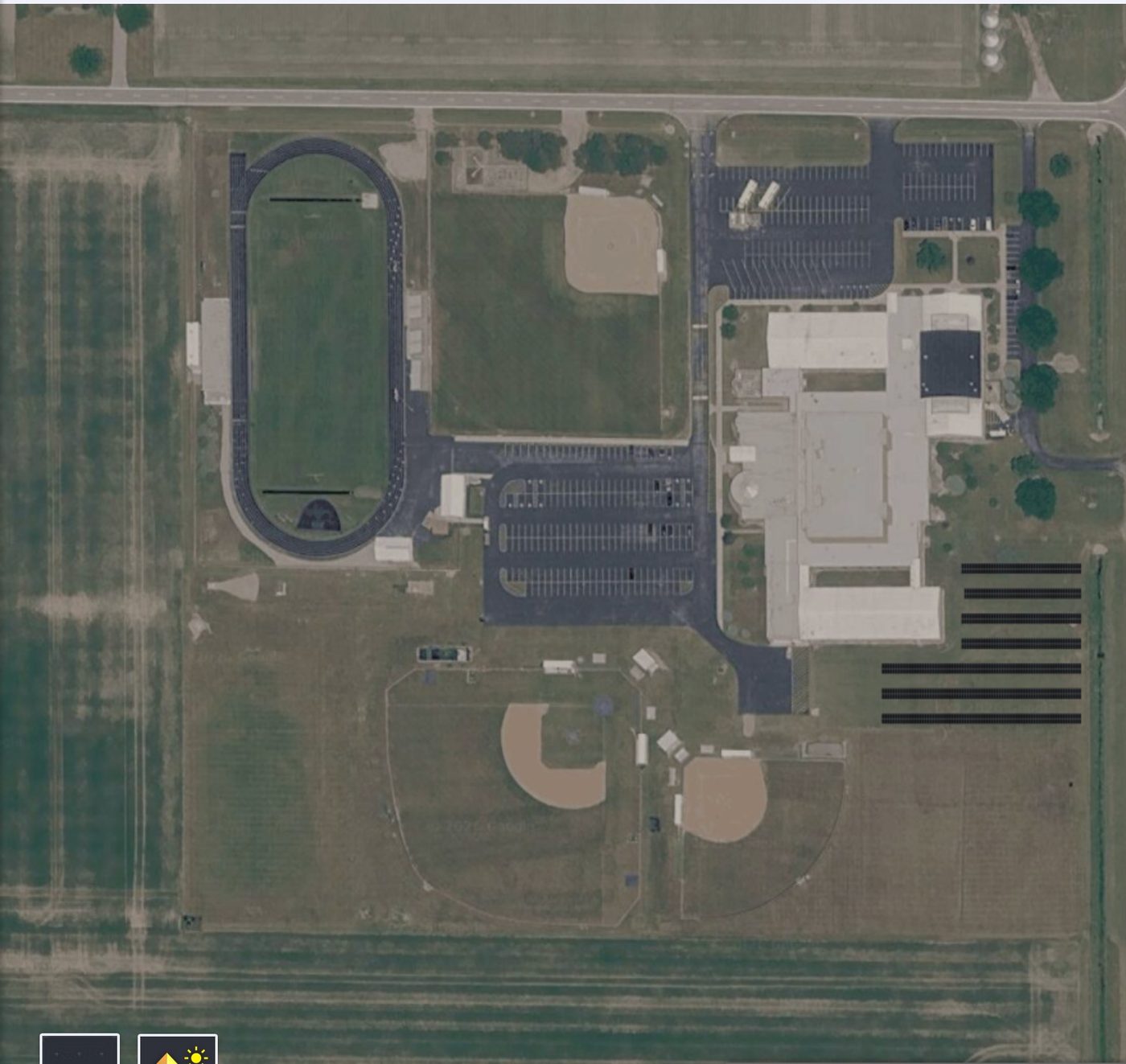
Aerial view of Wayne Trace High School campus showing proposed ground-mount solar array southeast of the building near the track

High School

Open grass southeast of the building — clear of the track, ball fields, and bus loop.

500 kW
System size
~$78K
Saved / yr
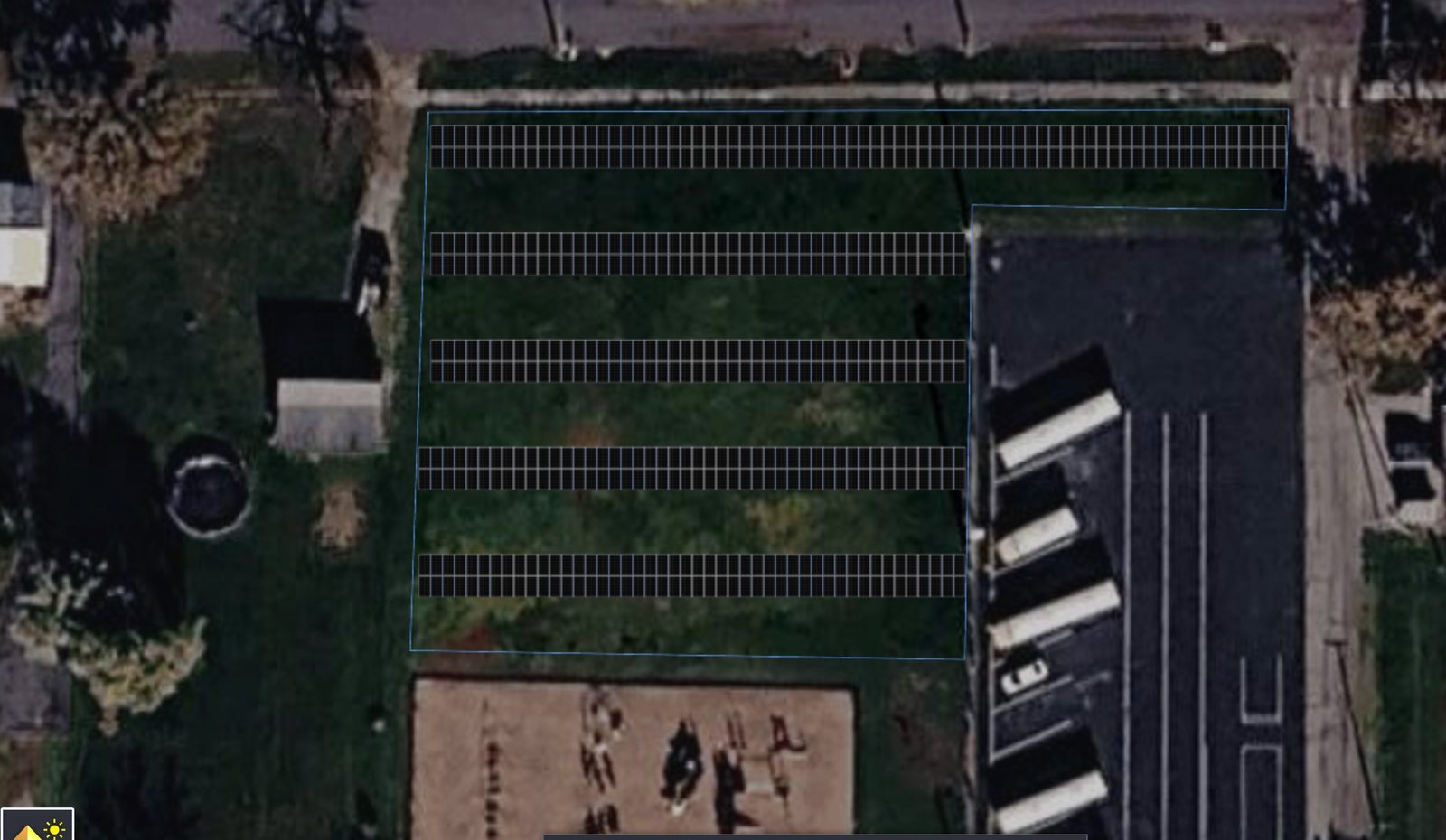
Aerial view of Payne Elementary showing proposed solar panel rows on the green space beside the building, away from the playground and buses

Payne Elementary

A compact footprint beside the building, clear of the playground and bus lane.

275 kW
System size
~$50K
Saved / yr
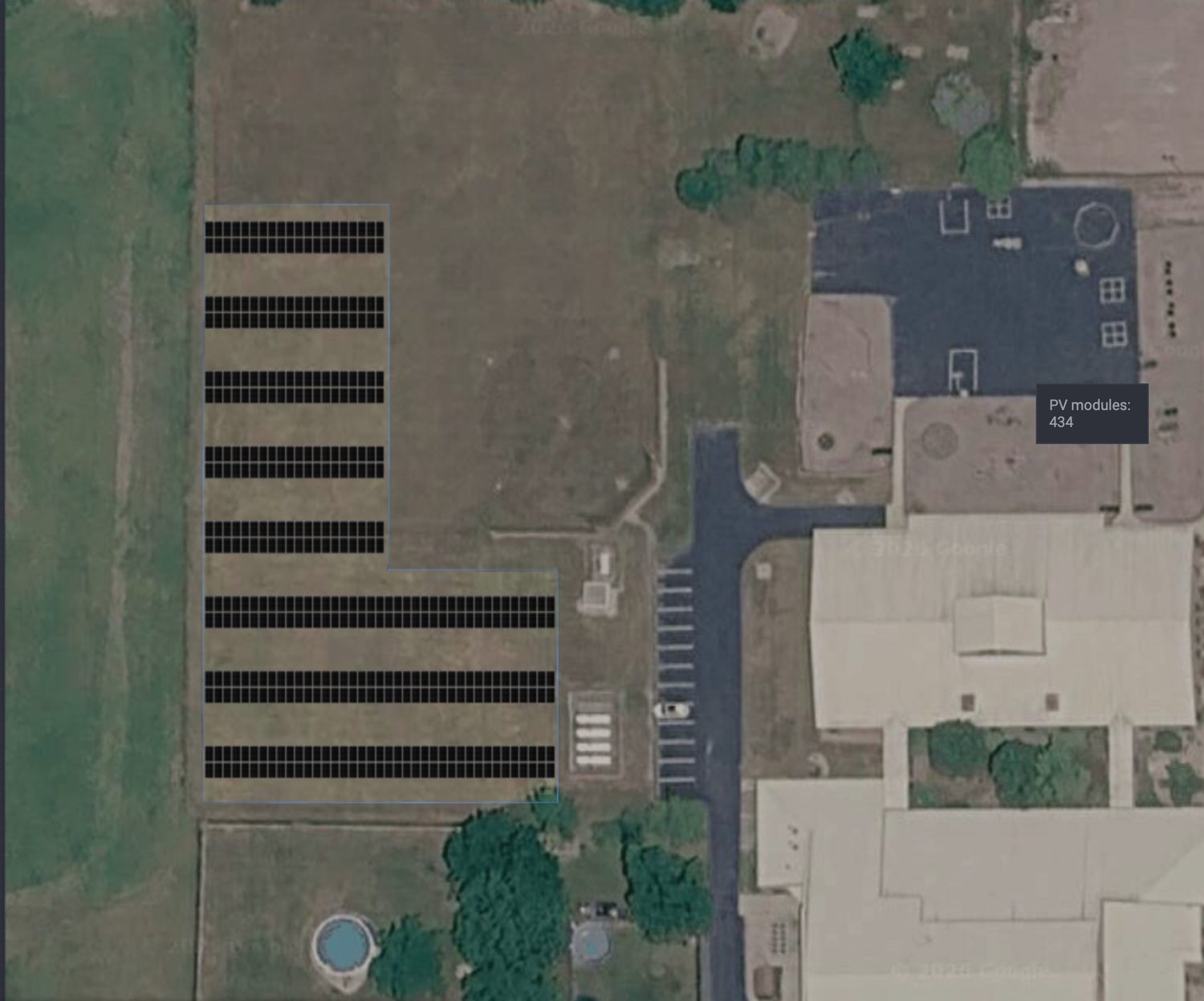
Aerial view of Grover Hill Elementary showing an L-shaped proposed solar array in the open field west of the building, labeled 434 PV modules

Grover Hill Elementary

An L-shaped array of 434 panels in the open field west of the building.

275 kW
System size
~$50K
Saved / yr

One more thing.

It teaches.

The same array streams live data into every classroom — and opens real career pathways, from solar technician to engineer.

Try the interactive living lab

Own the asset.
Keep the savings.
Teach with it for 30 years.

About $1.05 million, returning $178,000 a year — and roughly $5.2 million kept in Wayne Trace classrooms over 20 years.